
What Breaks When Your SaaS Hits Product-Market Fit: The Re-Architecture Decisions That Actually Matter (2026)
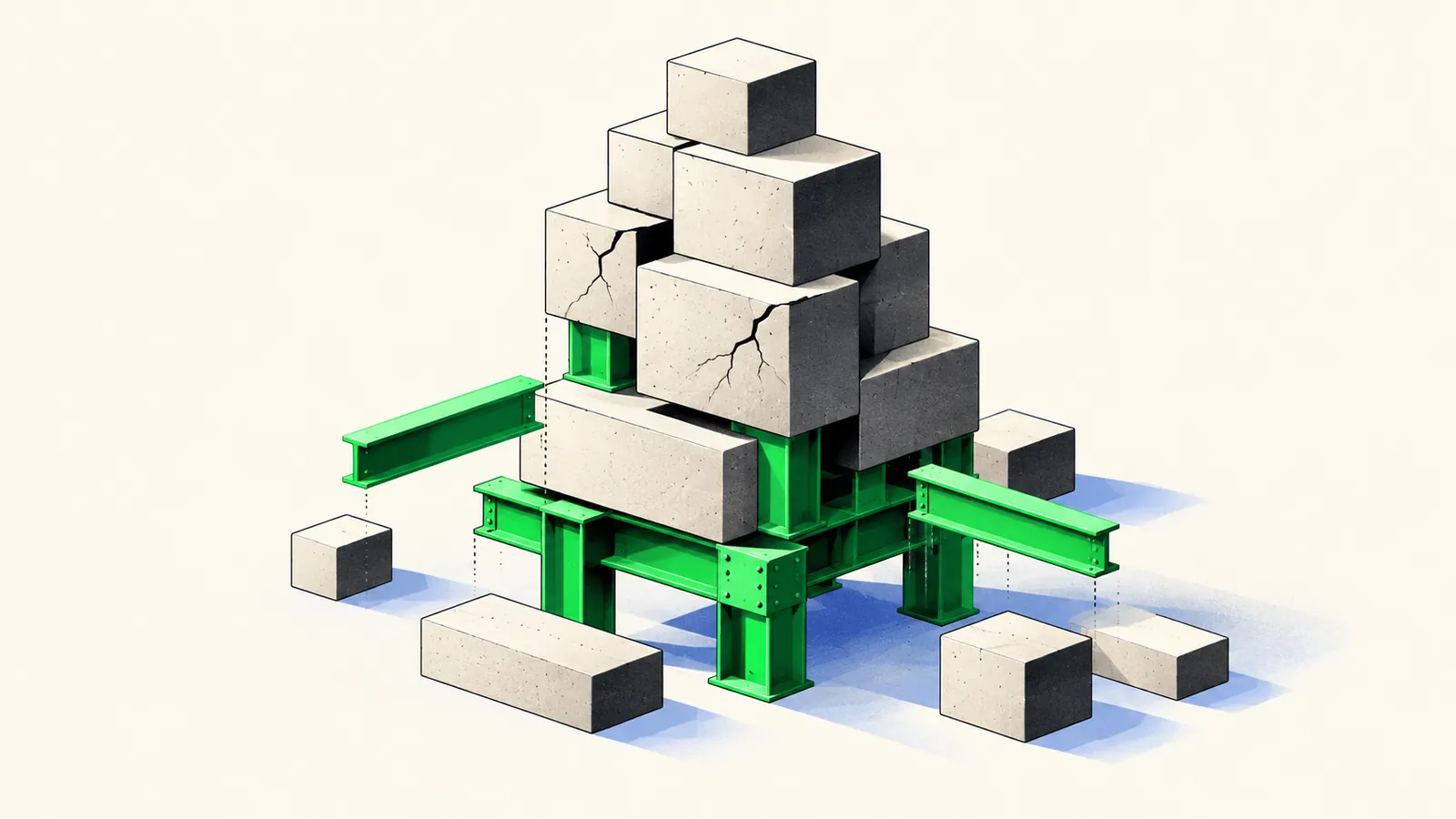
Product-market fit doesn't break your product. It breaks five specific subsystems, and the most expensive mistake founders make at this moment is treating that as a reason to "rebuild it properly."
Here's the honest version. When the traction finally arrives, the conventional vendor framing shows up right behind it: your architecture won't scale, multi-tenancy is a strategic imperative, let us rebuild it. That's selling you a six-to-twelve-month project you very likely don't need. The real work after PMF is almost always surgical (one subsystem at a time), and knowing which one fails first is worth more than any rewrite.
At Keplaris we design multi-tenant data models and Stripe billing for client SaaS products, and we re-architect client builds on Next.js, TypeScript, Node, PostgreSQL, and Stripe. So this is the view from a team that does the incremental work, not an agency selling you a rebuild.
The stakes are runway. Among 431 VC-backed startups that shut down since 2023, 70% cited running out of capital as the final cause, even though 43% failed from poor product-market fit as the root cause (CB Insights). A re-architecture that burns two quarters of runway is not a technical decision, it's an existential one. This guide is about spending the least to fix the part that actually matters.
Why the MVP architecture worked at 50 customers and dies at 500
Your MVP wasn't wrong. Single-tenant shortcuts, hardcoded plans, and eager-everything queries are the correct decisions before PMF, when validation speed is the only thing that matters. We made that case in what a SaaS MVP really costs in 2026: pre-PMF, the expensive sin is building the wrong thing well.
The inflection is that the same patterns which compounded velocity early now compound as interest. McKinsey estimates technical debt at 20 to 40% of the value of a technology estate before depreciation, with companies paying an extra 10 to 20% on top of every new project just to service it (McKinsey). Independent research points the same direction: organizations carrying high technical debt spend an estimated 10 to 20% more engineering effort to deliver identical outcomes (SIG, via Cerebral Ops).
And deferral is the most expensive choice of all. Fixing a defect in production can cost up to ~30x more than fixing the same issue earlier in the lifecycle (DeepSource, citing NIST), and architectural decisions deferred until after you've scaled are exactly the kind that mature into production-stage fixes.
The honest caveat: most of your codebase is fine. The job isn't a blanket rewrite. It's identifying the one load-bearing subsystem that fails first. Here are the five candidates, in the order they tend to force a decision.
Failure mode 1: the single-tenant data model
Symptom: tenant_id was bolted on late (or isn't there at all), there's no row-level isolation, a query forgets its filter and one customer sees another's data, and you can't safely index per tenant.
This is the decision-driving boundary. Just as the authorization boundary is the thing you can't fake your way around when taking a vibe-coded prototype to production, the tenant-isolation boundary is the one subsystem you cannot incrementally hand-wave. Tenant context has to thread through auth, queries, jobs, and billing, which is why the data model usually gates the other four.
What does fixing it actually cost? A documented single-tenant-to-multi-tenant migration at GrantStream ran about $100,000 in re-engineering and returned roughly 3x faster tenant setup with fewer bugs (Springer case study), a concrete third-party number the vendor pillar pages won't show you.
And you rarely need the binary "go fully multi-tenant" sermon. The pragmatic shape is hybrid tenancy: a pooled standard tier for the many, plus isolated (silo) infrastructure for enterprise tenants who demand it. Roughly 70 to 75% of new SaaS now ships multi-tenant by default (directional, but the trend is real), what matters is that you don't over-isolate the 95% of customers who'd be perfectly happy pooled.
Failure mode 2: hardcoded billing and plan logic
Symptom: plans, limits, and entitlements live as if statements scattered through the codebase; usage metering is bolted onto individual endpoints; there's no clean line between pricing and product.
This is the most expensive thing to fix late, because every future move (a price change, a usage-based tier, a one-off enterprise contract) collides with assumptions baked into the MVP. Late billing-stack re-architecture commonly runs several times the cost of building the entitlement layer correctly the first time, which is just the ~30x production-fix multiplier (DeepSource/NIST) showing up in your billing system.
The fix is not "switch billing providers." It's an entitlement layer: decouple plan definition from enforcement, so Stripe (or whoever) becomes swappable behind a clean interface. Stripe plans, usage metering, proration, and webhook-driven entitlements are the billing layer we build for clients, and we walk through the metering half, from the usage ledger to reconciliation, in our guide to usage-based billing for SaaS.
The caveat that the rebuild-everything crowd skips: if you're still pre-enterprise on simple flat plans, this can wait. Don't re-architect billing before the business model demands it.
Failure mode 3: query patterns that scaled linearly and now don't
Symptom: the dashboard that loaded in 200ms at 50 customers now times out, because the ORM is firing one query per row.
The N+1 problem is the cheapest high-leverage win in the entire re-architecture. In a 1,000-record benchmark, the N+1 pattern averaged ~2.14 seconds, versus ~0.065s with eager loading (≈33x faster) and ~0.024s cached (≈89x faster) (freeCodeCamp).
Crucially, this is a refactor, not a rebuild. N+1s, missing indexes, and unbounded queries are localized, measurable, and fixable subsystem by subsystem. And the sequencing matters: profile and fix the worst queries before any tenancy migration, because moving bad query patterns into a multi-tenant model just relocates the problem. Often these fixes alone buy enough runway to defer the bigger re-architecture past your next funding round.
Failure mode 4: auth and tenant-context leakage
Symptom: authorization checks quietly assume a single org, JWTs carry stale tenant claims, and one admin endpoint forgets the tenant filter, the classic cross-tenant data exposure.
This is the subsystem where "fix it later" is indefensible, because a single tenant-context leak isn't a bug, it's a breach. The risk is elevated right now because so many MVPs are AI-built: Veracode tested over 100 models and found 45% of AI-generated code samples failed security tests and introduced OWASP Top 10 vulnerabilities, with no improvement from newer or larger models (Veracode 2025). Apiiro found AI assistants drove ~4x faster code generation but a 10x increase in security findings, with privilege-escalation paths up 322% (Apiiro).
The fix pattern is to enforce tenant scope in two places only: at the database (PostgreSQL row-level security) and in a single middleware layer: never per-endpoint by hand, where one forgotten filter becomes the incident. (We go deeper on the authorization boundary in the vibe-coded-to-production guide.) For a new build, we ran the ways that policy fails on a real Postgres in multi-tenant SaaS architecture with Postgres RLS.
Failure mode 5: background-job contention
Symptom: one big customer's bulk export or webhook storm starves every other tenant's jobs, because they all share one queue with no per-tenant fairness.
Pooled multi-tenancy makes this worse before it gets better: shared infrastructure means one tenant's spike becomes everyone's outage, the noisy-neighbor problem. The fix is per-tenant rate limits, fair-share queuing, and isolating your heaviest enterprise tenants. This is the operational half of the hybrid-tenancy model, and a natural fit for the kind of workflow and job orchestration work that has to survive at scale.
The sequencing caveat: this is usually the last thing to fix, not the first. Don't over-invest in elaborate fair-share queuing before the tenancy and query work that actually causes the contention is done.
Refactor vs rebuild: the decision framework
The real test mirrors the one from the vibe-code rebuild: the decision hinges on (a) whether the data model can absorb tenant isolation (tenant_id + row-level security) and (b) whether your team actually understands the current code, not on how many lines get rewritten.
- Incremental refactor wins when the data model can take tenant isolation, failures are localized (queries, jobs, entitlements), and the team knows the codebase. Most post-PMF SaaS land here.
- Rebuild is genuinely warranted only when tenancy can't be retrofitted without rewriting the data layer anyway and the architecture is opaque to the current team.
Here's the part the vendor won't say out loud: a full rebuild under scaling pressure is a large IT project, and large IT projects have a brutal record. McKinsey and Oxford found projects over $15M run 45% over budget, 7% over time, and deliver 56% less value than predicted, and 17% go so badly they threaten the company's existence (McKinsey/Oxford). About 70% of digital transformation projects miss their goals (summary of McKinsey/BCG/Bain data).
What actually decides the outcome isn't the methodology, it's scope clarity. Projects with clear requirements before development were 97% more likely to succeed, while agile-style efforts that started before requirements were clear had a 65% failure rate (268% higher) (Engprax). For a re-architecture, that means an undefined tenant-isolation boundary, not the choice between refactor and rebuild, is the thing most likely to sink you.
The numbers, side by side
| Approach | Typical trigger | What survives | Rough cost & timeline* | Risk to live customers | Who you hire |
|---|---|---|---|---|---|
| Targeted refactor (queries, indexes, entitlement extraction) | Localized perf/billing pain | Most of the app | Lower / weeks | Low | Senior engineer or staff aug |
| Incremental tenancy migration (strangler fig, RLS, hybrid pooled + isolated) | Single-tenant data model | Data model + UI | Mid / 2 to 4 months (~$100K anchor) | Medium (run in parallel) | Small senior team / studio |
| Full greenfield rebuild | Tenancy un-retrofittable and opaque code | Spec & lessons only | Highest / 6 to 12 months | Highest | Studio that owns architecture |
*Directional ranges, not quotes; an audit sets the real number. For greenfield budgeting, see what a SaaS MVP costs in 2026.
The verdict in plain terms: refactor when failures are localized, migrate incrementally when only the data model is the problem, and rebuild only when the architecture genuinely can't carry real tenants.
Don't outsource the part where the knowledge lives
There's a reflex to hand the rebuild to an outsourcer the moment scaling pain hits. Be careful: 20 to 25% of outsourcing relationships fail within two years, and roughly 50% within five (Dun & Bradstreet, via TSH). The code understanding lives in your current team; an incremental refactor keeps that knowledge in the loop, while a wholesale outsourced rebuild throws it away at the exact moment you need it most. (If you're weighing team structure more broadly, we laid out studio vs in-house vs freelancers, keyed to runway.)
Runway is the deciding constraint. Companies with 12+ months of runway have ~3.5x better survival odds than those under six (First Round). If a multi-month rebuild would burn your cushion, the incremental path isn't just cheaper, it's safer.
And don't expect AI to rescue a rebuild. METR's randomized controlled trial of experienced developers on real repositories found them 19% slower with AI tools, even though they predicted a 24% speedup (METR). The 2024 DORA report tied a 25% increase in AI adoption to 1.5% lower throughput and 7.2% lower stability (Google Cloud / DORA). AI's speed advantage is front-loaded into greenfield prototyping; it fades exactly where re-architecture lives. Our honest bias is incremental, and we'll name the cases where a studio rebuild genuinely wins: opaque code, un-retrofittable tenancy, and the funded runway to absorb it.
The order of operations that avoids a big-bang rewrite
- Profile and fix the worst N+1 / index / query offenders first: the cheapest runway-buying win.
- Extract entitlements and metering out of product logic into a swappable layer.
- Lock the tenant-isolation boundary at the database with row-level security and a single middleware layer.
- Migrate tenancy incrementally with the strangler-fig pattern, so both models live at once.
- Add per-tenant fairness to jobs and queues last.
Pre-migration readiness checklist:
- Tenant-isolation boundary defined in writing (this is step zero; an undefined boundary is the #1 cause of failure)
- Backups and a tested rollback path
- Parallel-run plan so both data models can coexist
- Query performance baseline captured before any change
- Scope frozen before code starts
Why this sequence: each step buys runway and de-risks the next. The data-model migration is the riskiest, so it goes after the cheap wins and after the boundary is written down. The strangler fig is what keeps it from becoming a big bang: you route new tenants and features through the new model while the legacy path keeps serving live customers, so nobody experiences a cutover.
None of these steps means splitting the app into services. "Extract" in step 2 means a module with its own interface inside the same deployable. If microservices come up as part of the plan, check the split signals in monolith vs microservices for a startup first.
Where Keplaris fits
This is squarely our API & SaaS development work, the re-architecture itself, and, when an opaque codebase genuinely warrants a studio-owned rebuild, our product design & engineering practice. We design multi-tenant data models and Stripe billing for client SaaS products, and we build and run our own production product, Tether, so we apply this framework as engineers who operate what we ship.
What we actually sell here is an honest audit. We'll tell you which single subsystem to fix first, and if the answer is "don't rebuild, just fix your queries and keep your team," we'll tell you that too, even though it's the smaller engagement.
The bottom line: PMF doesn't demand a rewrite. It demands that you find the one subsystem holding the most weight, fix it surgically, and protect your runway while you do. Talk through your scaling inflection with us before you spend a dollar or burn a quarter of runway on a rebuild you may not need.
Frequently asked questions
What actually breaks when a SaaS hits product-market fit?
Not your whole product. Usually five specific subsystems that encoded single-tenant, low-scale assumptions: the data model, hardcoded billing and plan logic, query patterns (N+1 and missing indexes), auth and tenant-context handling, and background-job contention. The data model and auth boundary are the ones that force a real decision because you can't incrementally fake your way around tenant isolation. Most of the rest of your codebase is fine. The job at PMF is to find the load-bearing subsystem that fails first, not to rewrite everything.
Should I refactor my SaaS incrementally or rebuild it from scratch?
The decision hinges on two things: whether the data model can absorb tenant isolation (adding tenant_id plus row-level security) and whether your team actually understands the current code, not on how many lines get rewritten. Refactor incrementally when failures are localized to queries, jobs, and billing logic and your team knows the system; this is where most post-PMF SaaS land. Rebuild only when tenancy genuinely can't be retrofitted without rewriting the data layer anyway and the architecture is opaque to the current team. Beware the vendor push to 'rebuild it properly': McKinsey found large IT projects run 45% over budget and deliver 56% less value than predicted.
How much does it cost to re-architect a single-tenant SaaS into multi-tenant?
Treat any single figure as directional; the audit sets the real number. As a published anchor, a documented single-tenant to multi-tenant migration (GrantStream) cost about $100,000 in re-engineering and returned roughly 3x faster tenant setup with fewer bugs. A targeted refactor of queries and entitlements can run far less and take weeks; a full greenfield rebuild can run 6-12 months and carries the highest risk. The cheapest mistake is deferring tenant-isolation decisions until after scale, since a production-stage fix can cost up to ~30x more than an earlier one.
Why is fixing billing logic so expensive if you wait until after PMF?
Because hardcoded plans, limits, and usage metering get scattered as if-statements throughout your code during the MVP, and every later pricing change, usage tier, or enterprise contract collides with those baked-in assumptions. Late billing-stack re-architecture commonly runs several times the cost of building an entitlement layer correctly the first time, consistent with the broader pattern that production-stage fixes cost up to ~30x more than earlier ones. The fix is to decouple plan definition from enforcement so your billing provider becomes swappable, not to switch billing providers. If you're still on simple flat plans with no enterprise deals, this can safely wait.
Will AI tools make a SaaS rebuild faster and cheaper?
Not on a real, mature codebase. A randomized controlled trial by METR found experienced developers were 19% slower with AI tools on existing repos, even though they predicted a 24% speedup. The 2024 DORA report tied a 25% increase in AI adoption to 1.5% lower delivery throughput and 7.2% lower stability. AI's speed advantage is front-loaded into greenfield prototyping and shrinks once the code is real and the architecture matters, which is exactly the part a re-architecture is about.
Should I outsource the re-architecture to a dev shop?
Be careful with the reflex to hand a rebuild to an outsourcer the moment scaling pain hits. Dun & Bradstreet data shows 20-25% of outsourcing relationships fail within two years and roughly 50% within five. The code understanding lives in your current team, and an incremental refactor keeps that knowledge in the loop; a wholesale outsourced rebuild discards it. Runway is the deciding constraint. First Round found companies with 12+ months of runway have 3.5x better survival odds, so if a multi-month rebuild would burn your cushion, the incremental path is usually the safer bet.
Get in touch.
Whether you have questions or just want to explore what's possible, we're here to help.