
How Long Does It Take to Build a SaaS MVP in 2026?
"How long will the MVP take?" is usually the second question a founder asks, right after cost. Ask five vendors and you'll get everything from two weeks to nine months, and the strange part is that none of them are lying. They're describing different artifacts, with different definitions of done, and quietly excluding different chunks of the calendar.
So here's the honest answer up front, and then the rest of this post earns it: a real custom SaaS MVP, built by an experienced dedicated team, typically takes 10 to 16 weeks from kickoff to real users. No-code validation builds run 4 to 6 weeks. Regulated products run 6 to 12 months. And the two claims you should treat with the most suspicion are opposites: the agency quoting 6+ months for a straightforward product, and the pitch that AI now builds production MVPs in days. There's a randomized controlled trial on that second one, and we'll get to it.
Why the Quotes Disagree: Three Different Artifacts Share One Name
Most timeline confusion dissolves once you separate three things that all get called "MVP":
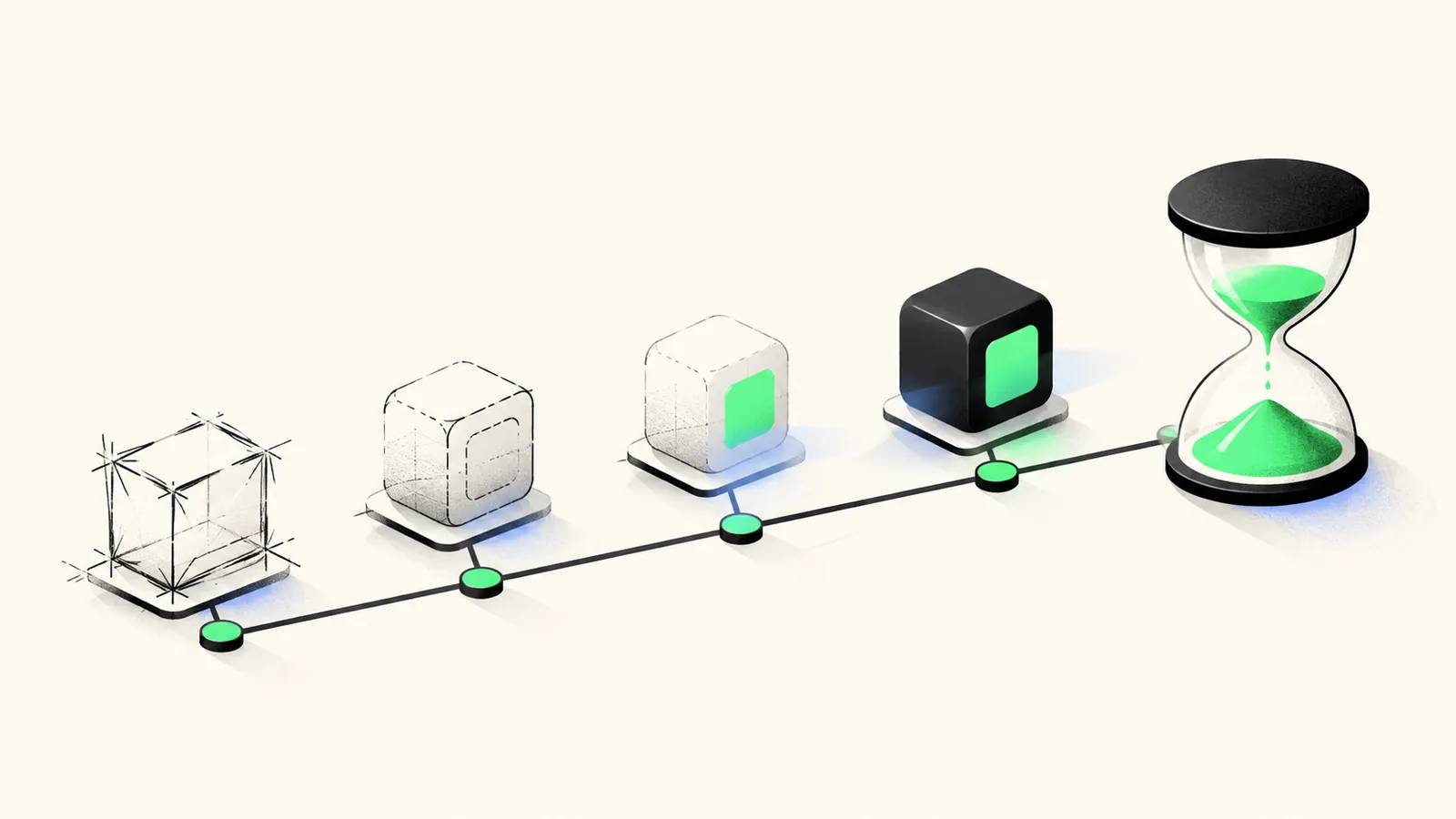
- A prototype proves the concept: a clickable design, a landing-page test, or an AI-generated demo. Days to 2 weeks. Its job is to create evidence and conversations, and it does that brilliantly. What it isn't is a foundation; we've written about what happens when a vibe-coded prototype quietly becomes the product, and it's the most expensive shortcut in early-stage software.
- An MVP is the smallest product real users can rely on: it takes payments, protects data, handles errors, and can be iterated without a rewrite. Weeks, not days; also weeks, not quarters.
- A v1 is the MVP plus everything the founder couldn't bear to cut. This is what 6-to-9-month quotes usually describe, and the fix is scoping, not scheduling.
Industry figures cluster once you control for that. Altar's analysis of the MVPs they've shipped puts the average around four months with three months most common; most 2026 agency guides land in the 8-to-16-week band for a custom build. Our own delivery data sits in the same band, and the spread within it is explained almost entirely by scope discipline and decision speed, not by engineering talent.
The Timeline Table, by Build Type
What each range includes: discovery, design, build, QA and hardening, and a production launch. What none of them include: the weeks that follow launch, which are the actual point of an MVP.
| Build type | Realistic timeline | What's driving the time |
|---|---|---|
| No-code / low-code validation MVP | 4-6 weeks | Tool constraints do the scoping for you; most time goes to workflow design and content |
| Custom SaaS MVP (one core workflow, 3-5 features) | 10-16 weeks | Real auth, billing, data model, and hardening; the middle 6-10 weeks is the build itself |
| SaaS MVP with a substantive AI feature | 12-20 weeks | Everything above plus evaluation sets, prompt and retrieval iteration, and cost tuning; we covered why in our AI development cost guide |
| Regulated product (fintech, health) | 6-12 months | Compliance review, security audits, third-party verification, and partner approvals dominate; engineering is often not the critical path |
A quote meaningfully below the band for your build type is describing a prototype or excluding phases. A quote meaningfully above it is describing a v1, padding, or a team that isn't dedicated to your project. All four are worth asking about directly; the answers are diagnostic.
Where the Weeks Actually Go (Including the Ones Nobody Quotes)
For the 10-to-16-week custom build, the anatomy looks like this. The percentages matter more than the absolute weeks, because they scale with the project.
Discovery and scope: 1-2 weeks. Problem definition, user flows, the cut list, the data model sketch, and the integration inventory. Teams skip this to "save time" and pay for it triple during the build, because every undefined behavior becomes a mid-sprint decision. This phase is where the timeline is actually determined; everything after is execution.
Design: 2-3 weeks, overlapping the build. Wireframes to working UI patterns. Running design fully before development is the classic way to add a month; a working pattern library and per-feature design that stays one sprint ahead of engineering is how the overlap works without chaos.
Core build: 6-10 weeks. Auth, the data model, the one core workflow that is the product, billing, and the two or three integrations that matter. Weekly demos on a staging URL are non-negotiable here, both for steering and because they force the decisions to happen on schedule.
Hardening and launch: 1-2 weeks. QA on real devices, error states, monitoring and alerting, backups, and the deployment pipeline. This is the phase most often deleted from optimistic quotes, and its absence is why some "6-week MVPs" spend their first month of life on fire.
Then there are the calendar risks that live outside the engineering plan, which cause more slips than code does:
- Third-party clocks. Payment provider account verification, App Store review, API access approvals, and a customer's IT department configuring SSO all run on someone else's schedule. Start them in week one, not week ten.
- Decision latency. Every "we'll get back to you on that" costs calendar time that looks like engineering slowness in the retro. An agreed 24-to-48-hour turnaround on decisions is worth more than an extra developer.
- Requirement churn. Changes discovered mid-build cost multiples of changes made on paper during discovery. The cut list is the defense, and every addition after kickoff should visibly trade out something else.
What AI Actually Does to the Timeline
The loudest 2026 claim in this space is that AI-assisted development collapses a 3-to-6-month MVP into a week or two. Since agencies making that claim are quoting against us, we have every incentive to check it carefully, so here is the best evidence available.
The only randomized controlled trial on the question is METR's July 2025 study: 16 experienced open-source developers, 246 real tasks in mature codebases they knew well, each task randomly assigned to AI-allowed or AI-disallowed. The result surprised everyone including the researchers: with AI tools, developers took 19% longer. The sharper finding is the perception gap: afterwards, the same developers estimated AI had made them 20% faster. Measured reality and self-report pointed in opposite directions.
Two honest caveats before anyone weaponizes that number. METR itself labels the result historical: the tools were early-2025 vintage and both models and workflows have improved since. And the setting (experts working in large codebases they know intimately) is close to the worst case for AI assistance; greenfield MVP work, which is mostly scaffolding, boilerplate, and first drafts of standard patterns, is close to the best case.
So the defensible synthesis, which matches what we see on our own projects: AI meaningfully accelerates the typing, and it doesn't accelerate the deciding. On early build phases of a greenfield MVP we see real gains, roughly 20 to 40% on scaffolding-heavy weeks. Integration debugging is about neutral. And the saved hours partially move downstream, into reviewing generated code and fixing its confident mistakes. The net effect on a 12-week timeline is that the build phase shrinks by a couple of weeks; it does not shrink to days. When a pitch says otherwise, ask which of the phases above it eliminated, and listen for whether the answer is "hardening."
Why Timelines Slip Anyway: The Base Rates
Even with a good plan, the industry's track record argues for humility. McKinsey and Oxford's landmark study of 5,400 IT projects found large projects run on average 45% over budget while delivering 56% less value than promised. The Standish Group's CHAOS research has said a version of the same thing for three decades: in the 2020 edition, 19% of projects failed outright and another 50% were challenged on time, budget, or scope.
MVPs are smaller than the projects in those datasets, and small is protective. But the slip mechanisms are identical, just miniaturized: scope creep, late-discovered requirements, integration surprises, and optimistic estimates made under sales pressure. The practical protections all fit in one sentence: fix the scope before kickoff, demo weekly so drift is visible in days not months, start third-party clocks immediately, agree a decision SLA, and put a 20% buffer in the plan you communicate. A team that resists the buffer is telling you something about how they'll report bad news later.
Compressing the Timeline Without Cutting Corners
Every founder wants the range's left edge. The levers that get you there safely:
- Cut features, not phases. The scope post has the full method, but the test is brutal and simple: if the MVP works without it, it's not MVP scope. Cutting a feature saves its build time and its design, QA, and decision time.
- Buy the commodity layers. Auth, billing, transactional email, and file storage are solved products. Building any of them custom in an MVP is spending schedule on something no customer will notice.
- Overlap design and build. Serial phases are the lazy default; one sprint of lead is all design needs.
- Use no-code where the risk is market, not technology. An admin dashboard or an internal ops tool doesn't need custom code in month one.
- Answer questions fast. Cheapest lever on the list, most often ignored.
And the two things never to compress: discovery (it's 10% of the calendar and determines the other 90%) and hardening (it's the difference between launching and merely deploying).
Timeline, Cost, and Partner Are One Decision
The three questions founders ask separately are the same question. Timeline is scope divided by team throughput; cost is mostly timeline times team size; and the partner you pick determines whether the estimates were ever real. We've covered the other two corners of that triangle in How Much It Really Costs to Build a SaaS MVP and the buyer's guide to choosing an MVP partner, and the partner guide's diagnostic questions (fixed scope or not, who demos, what happens post-launch) are also the fastest way to test whether a quoted timeline deserves belief.
How We Run MVP Timelines at Keplaris
Our product design and engineering practice quotes in the bands above and runs the anatomy above: discovery with a written cut list, design one sprint ahead, weekly staging demos, third-party clocks started in week one, and hardening as a protected phase rather than a stretch goal. AI tooling is part of how we build, priced into the estimate as the modest real gain it is rather than marketed as magic. Most engagements land inside 10 to 16 weeks because the scope was fought over before kickoff, which is the least glamorous and most effective schedule technology ever invented.
If you're holding quotes that range from three weeks to nine months for the same product, talk to us. We'll tell you which artifact each quote is actually describing, and what your product's honest band is.
Frequently asked questions
How long does it take to build a SaaS MVP?
For a custom-coded SaaS MVP with an experienced, dedicated team: typically 10 to 16 weeks from kickoff to real users, covering discovery, design, build, and hardening. A no-code validation MVP runs 4 to 6 weeks. An MVP with a meaningful AI feature runs 12 to 20 weeks because evaluation and iteration take real calendar time. Products in regulated industries like fintech or healthcare run 6 to 12 months, mostly for compliance and third-party approval reasons rather than engineering ones. Quotes far below these ranges usually describe a prototype, not an MVP, and quotes far above them usually describe a v1 with too much scope.
Can you build an MVP in 2 weeks?
You can build something real in 2 weeks: a clickable prototype, a landing-page test, or an AI-generated demo that proves the concept. What you can't usually build in 2 weeks is a product that takes payments, protects user data, survives real traffic, and can be iterated on without a rewrite. That distinction matters because the fast artifact is a validation tool, not a foundation. If a two-week build gets you customer conversations, that's money well spent. Just budget separately for the production build, because prototype code that quietly becomes the product is one of the most expensive mistakes in early-stage software.
Does AI make MVP development faster?
Yes, but by nothing like the marketing claims, and not uniformly. The only randomized controlled trial on the question (METR, July 2025) found experienced developers were actually 19% slower with AI tools on real tasks in codebases they knew well, while believing they had been 20% faster. That setting differs from greenfield MVP work, where AI genuinely accelerates scaffolding, boilerplate, and first drafts; our own experience is a real but modest gain of roughly 20 to 40% on early build phases. The bottleneck then moves to decisions, review, and integration, which AI doesn't compress. Treat 'AI lets us build your MVP in days' as a claim about prototypes, not products.
What takes the longest when building an MVP?
Rarely the features. The reliable time sinks are: third-party dependencies (payment provider verification, app store review, API access approvals, SSO setup with a customer's IT team), integration debugging between services, client-side decision latency (unanswered questions and pending reviews routinely cost more calendar time than engineering), and the hardening phase that quotes love to omit: QA on real devices, error handling, monitoring, and a production deployment pipeline. Scope creep is the biggest self-inflicted one, and it's why fixing scope before the build starts matters more than any tooling choice.
How do you speed up an MVP timeline without cutting corners?
Cut scope, not phases. A smaller product built properly beats a bigger one built without discovery or hardening. The levers that actually work: ruthless feature cuts before kickoff, buying commodity pieces instead of building them (auth, billing, email, file storage), overlapping design and build instead of running them serially, an agreed 24-to-48-hour turnaround on client decisions, and using no-code for the parts where the risk is market demand rather than technology. Then add a 20% buffer anyway, because the base rates on software schedules are not in anyone's favor.
Get in touch.
Whether you have questions or just want to explore what's possible, we're here to help.