
How to Scope a SaaS MVP (and What to Cut First)
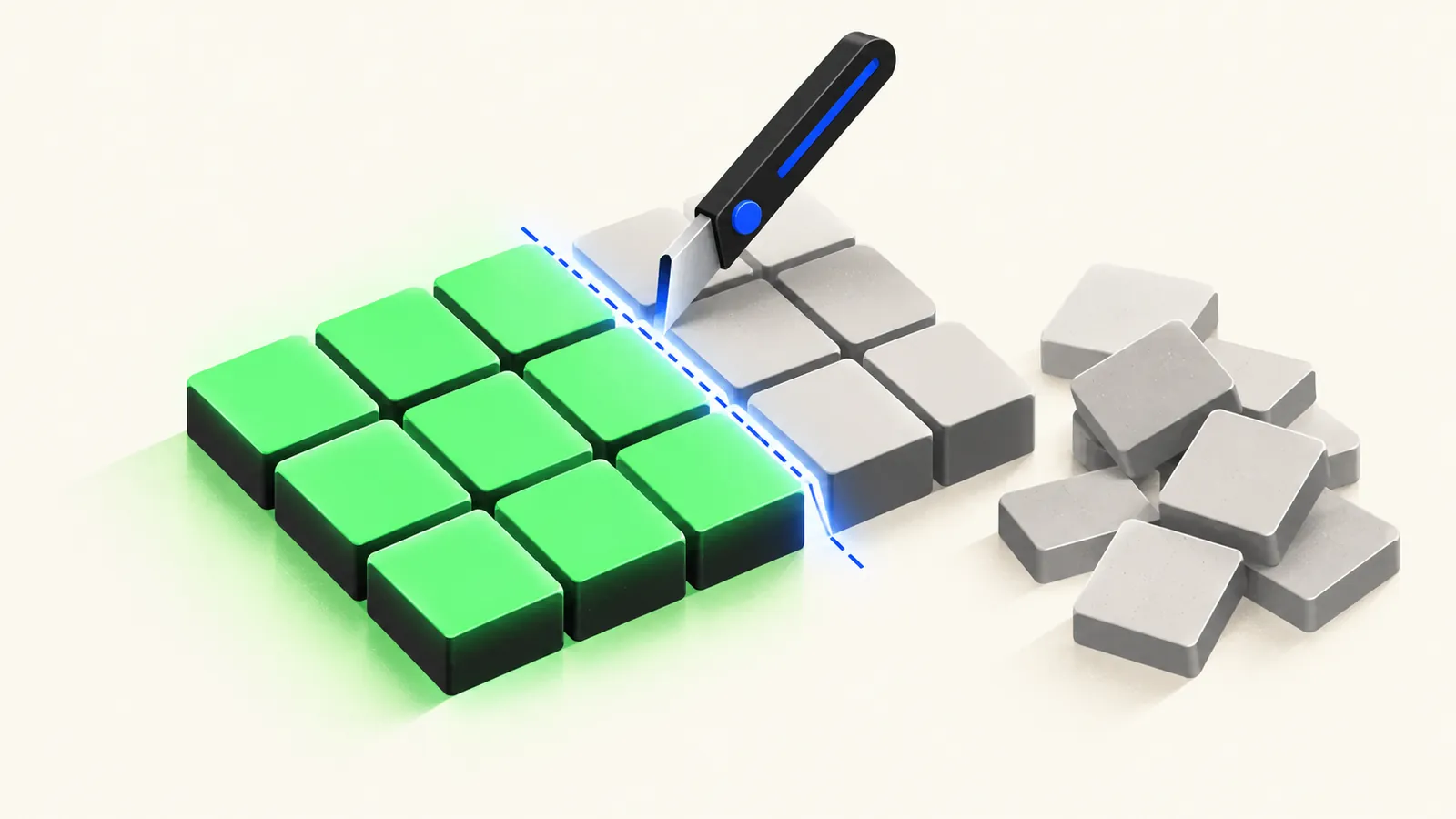
Most MVPs fail for the opposite reason founders expect. They don't fail because they were too small and missed a critical feature. They fail because they were too big: months of build, a sprawling feature list, runway burned, before anyone learned whether the core idea was even right.
Scoping a SaaS MVP is not the skill of deciding what to build. It's the skill of deciding what to cut. This guide gives you a framework for cutting well: how to find the one thing your MVP must prove, how to separate must-haves from nice-to-haves, and the specific categories of features to drop from v1 every time.
Start With the One Job, Not the Feature List
The most common scoping mistake is starting from a feature list. A list has no natural stopping point: every feature suggests three more, and "while we're at it" quietly doubles the build.
Start instead from a single question: what is the one job a user hires this product to do? Not the vision, not the platform it could become. The one outcome that, if you nailed it, would make someone choose you. Your MVP exists to deliver that one job and to prove people actually want it delivered.
Write it as a single sentence: "Help [a specific user] achieve [a specific outcome] without [the current pain]." If you can't compress your product to one sentence, you don't have a scoping problem yet. You have a focus problem, and that's where to start.
Everything in the MVP is then judged against that sentence. The feature list stops being a wish list and becomes a filter.
The Core Hypothesis: What Your MVP Actually Tests
An MVP is an experiment, and every experiment tests a hypothesis. Yours is usually some version of: "Users with [problem] will adopt [our core workflow] to solve it, enough to pay / return / rely on it."
That hypothesis decides your scope, because the only features you truly need are the ones required to:
- Deliver the core value: the workflow that does the one job, end to end.
- Let a real user actually use it: the minimum to get in and complete that workflow.
- Let you measure the result, so you learn whether the hypothesis held.
If a feature doesn't serve one of those three, it's not part of the MVP. That's the whole test. It sounds simple, and it is. The difficulty is emotional, not analytical. Cutting features feels like cutting ambition. It isn't. It's protecting your runway long enough to find out if the ambition is pointed in the right direction.
Must-Have vs Nice-to-Have: A Working Filter
Run every proposed feature through this table. Be honest: the goal is a short "must-have" column.
| Question about the feature | Must-have | Cut from v1 |
|---|---|---|
| Is it required to deliver the core value? | Yes | No: cut |
| Can a user complete the core workflow without it? | No, blocks the flow | Yes, it's optional |
| Does it help you measure adoption/retention? | Yes | No: cut |
| Is it a second use case or user type? | n/a | Yes: cut |
| Is it polish, an edge case, or an admin convenience? | n/a | Yes: cut |
| Would you delay launch a month for it? | Maybe | No: definitely cut |
A clean MVP usually has a surprisingly small must-have column: sign-up/auth, the one core workflow, and basic measurement. Almost everything else can wait for evidence.
What to Cut First (The Usual Suspects)
These are the features that creep into nearly every MVP scope and almost never belong in v1. Cut them first, and cut them confidently.
- Settings and configuration. Granular preferences, themes, customization. Pick a sensible default and ship it. Configurability is a response to real, varied usage you don't have yet.
- Roles and permissions. Multi-role access control is expensive and rarely needed to prove value. Start with one user type; add roles when teams actually adopt you.
- Admin dashboards. You can run early operations with database queries and spreadsheets. Don't build internal tooling before you have customers to administer.
- Integrations (beyond the one that's core). Each integration is its own mini-product to build and maintain. Keep only an integration that is the core value; defer the rest.
- Onboarding flows and empty states polish. A guided tour matters at scale. In an MVP you can onboard your first users by hand and learn far more by talking to them.
- Secondary use cases. The "it could also do X" features. X is a future bet; the MVP proves the primary bet first.
- Billing complexity. Tiers, proration, usage metering, coupons. If you need to charge, charge simply (one plan, Stripe), or even invoice the first customers manually. Log usage anyway, so you can add usage-based billing later on real data. The same goes for API quotas: rate limit tiers by billing plan can wait until you have more than one plan to tier.
- Scale and optimization work. Caching, sharding, micro-optimizations for traffic you don't have. Build for your first 100 users, not your imagined millionth.
Cutting these is not lowering quality. The part you keep (the one core workflow) should be genuinely good. You're concentrating your quality budget where it proves the idea, instead of spreading it thin across features no one has asked for yet.
Cut Scope Without Cutting Credibility
There's a real risk in cutting: shipping something so bare it tests nothing, because users bounce before they reach the value. Avoid it with two rules.
First, keep the core workflow end-to-end and excellent. Narrow is fine; broken is not. One complete, polished path beats five half-finished ones.
Second, never cut measurement. The cheapest thing to drop is analytics, and it's the one thing you can't. If you ship and can't tell whether users adopted the core workflow, you've spent the build and learned nothing. Instrument the funnel before you launch.
For the related question of how much all this should cost, see our breakdown of what it really costs to build a SaaS MVP in 2026. And once the MVP validates, the next discipline is knowing what to re-architect when you hit product-market fit, deliberately not building that future into v1 is part of scoping well.
A Simple Scoping Process You Can Run This Week
- Write the one-sentence job. User + outcome + pain removed.
- State the core hypothesis. What adoption would prove the idea.
- List every feature you imagine: get it all out of your head.
- Filter each against the must-have table. Keep only what delivers value, enables use, or measures it.
- Cut the usual suspects: settings, roles, admin, extra integrations, secondary use cases.
- Define "done" for v1 as the smallest end-to-end version of the core workflow.
- Set a learning goal: the metric that tells you to double down or pivot.
If your "must-have" list still looks like a year of work, you haven't found the wedge yet. Keep cutting until v1 is something a senior team could take from kickoff to real users in roughly 10 to 16 weeks (we break that range down in how long it takes to build a SaaS MVP).
How Keplaris Helps You Scope and Ship
Scoping is the highest-leverage decision in a SaaS build, and it's the easiest to get wrong when you're close to the idea. At Keplaris, scoping is the first thing we do, not an afterthought: we pressure-test the idea, define the wedge feature, cut an honest MVP your runway can actually support, and sequence everything else into a post-launch roadmap.
Then we build it. Keplaris is a product engineering studio that takes SaaS products from idea to production: product strategy, UX/UI design, full-stack React and Node.js engineering, launch, and post-launch iteration. It's the same end-to-end process behind Tether, the product we build and run ourselves, so the scoping advice here isn't theory; it's how we ship.
If you have a backlog of ideas and need help turning it into a shippable v1, book a free scoping call or explore our Product Design & Engineering service. The fastest way to a successful MVP is deciding what to leave out, and we'll help you draw that line. Once your scope is tight, use our guide on how to choose an MVP development partner to pressure-test whoever builds it.
Related reading: How Much It Really Costs to Build a SaaS MVP in 2026 · Product Engineering Studio vs Hiring Developers in 2026 · From Vibe-Coded Prototype to Production SaaS
Frequently asked questions
What should a SaaS MVP include?
A SaaS MVP should include only the features required to deliver and prove the one core value the product exists for (the single job a user hires it to do) plus the minimum supporting pieces to use it (sign-up, the core workflow, and a way to measure whether it worked). Everything else (settings, roles, integrations, polish, secondary use cases) is deferred until real usage justifies it. If a feature doesn't directly serve the core value or let you measure it, it does not belong in the MVP.
How do I decide what to cut from an MVP?
Map every proposed feature to the one core hypothesis you're testing. Keep only what's required to deliver that value and observe whether users adopt it. Cut anything that is a secondary use case, an edge case, an optimization, an admin convenience, or 'we'll need it eventually.' A useful test: for each feature ask, 'If we ship without this, can a user still get the core value and can we still learn from it?' If yes, cut it from v1.
How small should an MVP be?
As small as possible while still being genuinely usable for one real workflow by one real type of user. The goal is the shortest path to validated learning, not a tiny version of the whole roadmap. In practice that's often a single end-to-end flow that a real user would pay for or rely on, which an experienced team can typically take from kickoff to real users in roughly 10 to 16 weeks, not a year.
What's the difference between an MVP and a prototype?
A prototype demonstrates an idea (often clickable, not production-grade) to get feedback or buy-in. An MVP is real, working software that a real user can use to get real value, so you can measure actual adoption and retention. A prototype tests whether people like the idea; an MVP tests whether they'll use and keep using the product. Many teams need both, in that order.
How can Keplaris help me scope and build a SaaS MVP?
Keplaris is a product engineering studio that takes SaaS products from idea to production. We run a focused scoping process (pressure-testing the idea, defining the wedge feature, and cutting an honest MVP your runway can support), then design and build it full-stack (React/Node) and launch it. It's the same end-to-end process behind our own software. You can book a scoping call to turn a backlog of ideas into a shippable v1.
Get in touch.
Whether you have questions or just want to explore what's possible, we're here to help.